
So, after being anti-iPhone for a long time, (mainly because we weren't about to jump ship from Verizon) my husband finally hopped onto the bandwagon and got one of those trendy little rectangles.
 |
| Very Simple Augmented Reality. |
And, it's funny, you know. We really did think our BlackBerry Storms were so cool. But our Storms could only hold a measly five apps or so, and all those cool apps you hear about? Yeah. They're not usually available for BlackBerry.
But now, the app store is so chock full of cool STUFF that it's really hard to tear our eyes away. Not least of which are the plethora of augmented reality apps. These apps are so cool, they're kind of freaky. Your iPhone knows, and it knows you know it knows, and it is not intimidated.
Okay, so since augmented reality is a kind of klunky term for a really slick concept, let's define it, shall we? Mirriam Webster (m-w.com, my go to for all my word-defining needs) defines “augment” as “to make greater, more numerous, larger, or more intense.” So augmented reality is taking reality and adding to it. At present, it's a mainly visual augmentation. You have a camera (a webcam or your iPhone or Android camera) and it sees the world and ads images on top of that. It's your very own at-home (or wherever you are) CGI.
I think BusinessInsider.com said it well: “Think of an augmented reality app as a lens through which you can see the world. One lens might be restaurants near you, and another might be pointing out exactly how far away the pin is on a golf course.” They also have a good list for apps if you're in the market.
 |
| AR tattoo. |
Some AR (since it's so flipping long) programs require you to print an image out: they are programed to respond to that image. My firstexperience with AR was like this, and I'm glad its still on the web so I can share it with you. It's from GE's SmartGrid campaign. Hold up the target, and out pops an illustration of solar or wind energy (you can pick which one you want to do: I like the windmills best.) I like this one because I could easily draw the target image (I didn't actually need to print it) and when the 3D image is visible, you can also interact with it. Blow on the windmills, and they go around. Tip it down and you can see the Golden Gate Bridge.
Mobile AR apps, however, use other cues as to what to respond to. iPhones tend to use a combination of the camera, the gyroscope, and the GPS to add digital images on top of the “real” image the camera sees. In London and Chicago (at least!) you can get an app that knows which train station you are at, when your next train is coming, and what direction you should walk in for a burrito. All you have to do is turn your app on, and point your camera down the track. Your GPS knows where you are and the time of day, and it superimposes the information on your screen so the image you see is the real world—with more information displayed. Look at a restaurant, and Yelp can give you reviews, right on your iPhone screen. Walk down the street, or move your head and that image is stationary in “space.”
Another cool thing you can do is create AR with your Kinect. I am not nearly computery enough to do it (nor do I have 2 Kinects) but there are a couple videos on YouTube, including one where a computer savvy dude puts a 3D character from Doom on his desk. He speaks really quietly, so you'll have to turn up your volume, and the other images in the room are wobbly because of the “shadows” the cameras cast: the parts of the room the cameras can't see. But this is pretty fantastic. The idea that once you know the principles, you can create just about anything you can imagine...it makes me pretty excited.
This also makes me curious about the future. You're probably thinking it too: true virtual reality is just one step up from augmented reality. Today: we're putting wind farms in our hands, interacting with them. Tomorrow, we put glasses on that constantly feed information about the world around us straight into our eyeballs. Next week, our bodies are only there to support the brain, wired to experience a “better” reality.
I shudder to think.
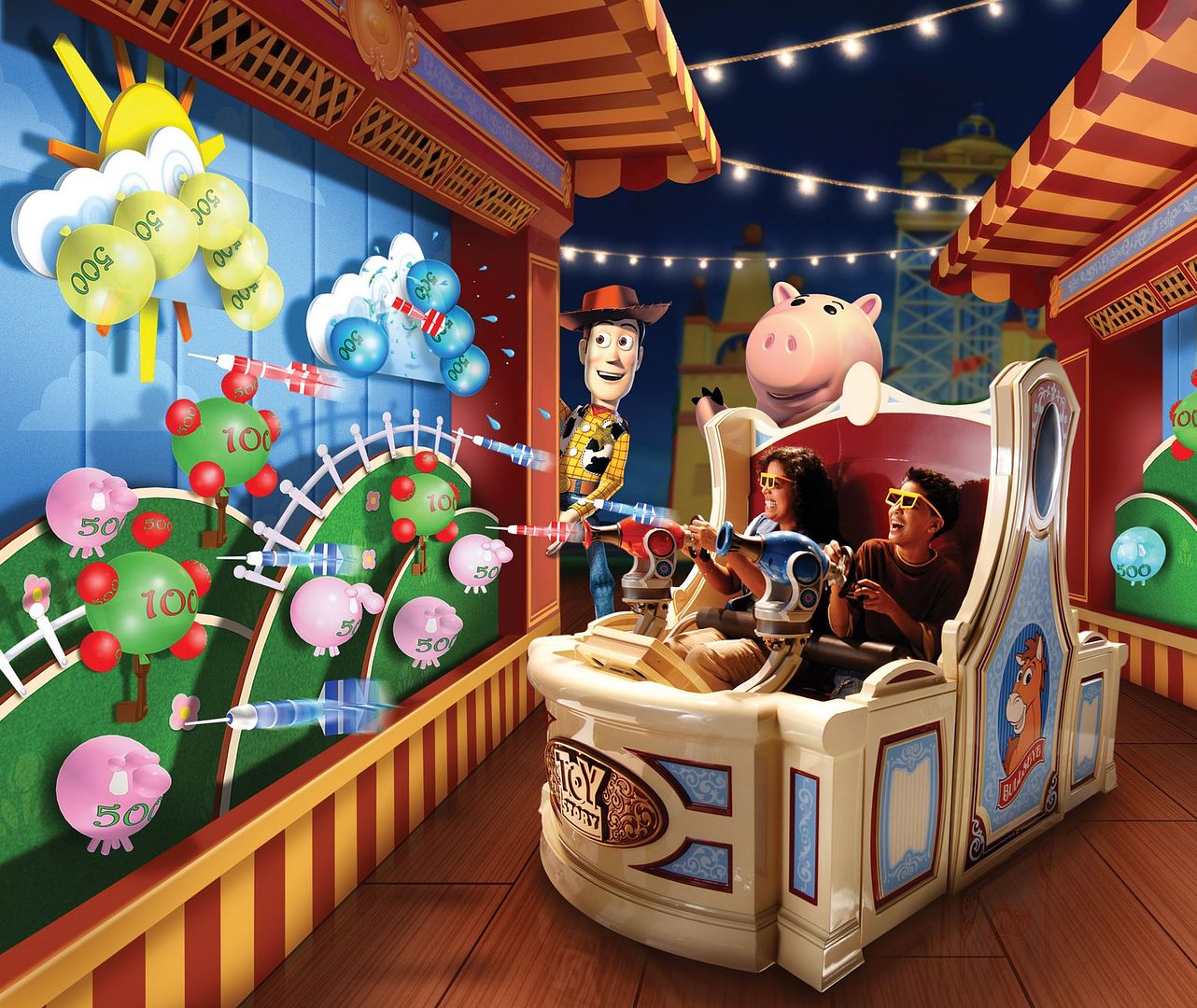 |
| ToyStory Mania in Hollywood Studios. (Go early & get a fast pass.) |
Okay, lets bring it back from the apocalypse. Say we don't give our lives over completely to virtual reality. Lets take a baby step (a really tiny step) to the kinds of games they have at Disney World. Toy Story Mania is probably one of the most popular rides in the whole (Disney) World. You ride in a car and play a series of 3D carnival games. You put on 3D glasses and have little guns that lob balls of paint or softballs or rings at targets. You pull a cord to shoot a ball or toss a ring. You have to aim. It looks, for all the world, as if these paint balls and rings are shooting out of your little cannon and into the scene before you. In some of the games, the carnival things attack back. Shoot a ring around a rocket and it comes shooting at you, along with puffs of air that elicit yelps and screams from the riders. As of right now, Disney is the only place (besides a real paint-and-plastic carnival) that has games quite this interactive. But 3D TVs are moving up from ridiculous extravagance to household norm pretty quickly, just like flat, wide-screen HD TVs did. (I can't imagine buying a big old tube set. I bet it would come with a free VCR.) And Kinect? You don't even need a controller. It sees you. Not only does it see you, it interprets the things you do and reacts accordingly, accurately!
You add Kinect and a 3D TV together, and Disney World's gotta up its game. The kids who go there in five years are NOT going to be impressed with Toy Story Mania. (I'm sure it will still be there, though. I mean, hell, Carousel of Progress is still there, and they are showing kids playing virtual reality in the 80s.)
But it could be beautiful. Imagine watching a movie with all the interactive technology Disney uses . You step into Lothlorien and smell the flowers. You step into Potions and feel the humid air. Surround sound easily lets you hear the chatter in the Great Hall. You wear a pedometer like device so you can walk around Hogwarts. Jets of air let you know when an orc's arrow hits you. You can smell the sweeter air that leads you out of the mines of Moria.

On the other hand, I was listening to @Pottercast's episode on @Pottermore, and in jest (I think) John Noe mentioned something about it being such an interactive reading experience that it would be like virtual reality. I immediately thought, “Wow, that is something that you would get addicted to and have to go into therapy to try and quit.” Wouldn't that level of escapism be detrimental to a person's mental health? I know when I have a bad day, I crave the thickest fantasy possible. I want to dive into Harry Potter or Lord of the Rings or Kushiel's Legacy. I want to get completely lost in another world. If it were possible for me to hop into virtual reality...It would be so easy to forget the real world. Or, can you imagine if World of Warcraft were virtual reality? It's already an addictive problem for some people. Who would ever leave?
But we're not quite there yet, and I think AR apps are kind of fabulous. They can be useful and fun all at once. My husband has one that puts a little robot dude on a piece of paper that you print that looks like the moon. You can bug him with your finger, and if you spin him enough, his head flies off! I think the application AR has for information distribution, gameplay and even fun little nothings like the little robot. In the UK, at the Natural History Museum, they just opened a Darwin building, and it has an entire room mapped for AR
“A film, Who do you think you really are?, features a unique film-making technology which allows Sir David Attenborough to take the audience on a virtual journey back through our evolutionary past, where digitally overlaid extinct creatures appear to roam around in the studio,”
Richard Smith writes on Culture 24. I would LOVE to see a room like this. Experiences like this, blending new technology with natural history and other sciences can help kids (and big kids like me) become more aware of science and technology. And the more people who are interested in science, the farther our world can advance.


