Showing posts with label animals. Show all posts

1.02.2012

The Uncanny Valley

I really do not like monkeys.

I know that many people think monkeys are cute, endearing, funny. When they see them in a zoo, they exclaim how similar they are to us. Even I have experienced this, holding up my grandma's "magic mirror" to the pane of glass and watching the little dark brown monkeys with their silky black fur coming up and looking at themselves in the mirror. These monkeys, catlike, with their thick fur and long glossy tails, didn't offend me much.

But then our zoo got a large habitat for chimpanzees.

These were not cute. They we're like hairy, messy, shameless humans. They screeched loudly. They stuck dirty fingers in up their wide nostrils and leered at the people who came to see them. They scratched their bare butts with long, cracked nails. They bared their teeth and shrieked.

The chimpanzees in the new section of the zoo were big news in my town. But I only lingered at their area for a few minutes before moving on. They made me uncomfortable, with their big, wet lips flopping back and showing brick-like yellow teeth. I wasn't bored. I was disgusted. And fearful. I felt uneasy, the way you do moments before something scary happens in a movie. I had to move away.

I had fallen into the uncanny valley.


The Uncanny Valley is the term for when an artificial character is very close to being human, and therefore eliciting a positive emotional response, but something about it is wrong and provokes feelings of revulsion or disgust. For example a corpse of a human looks exactly like a person...but instinctively we know that it is not alive and we are repulsed by it. For me, monkeys fall into that valley. They don't look like animals to me. They look like deformed humans, and that "close-but-no-cigar" quality makes me uneasy. It's the same reason people are afraid of clowns, dummies, ghosts, mummies, vampires, werewolves....they resemble humans, but a key element is missing. There is simply a wrongness that can be hard to define.

One way to bridge the Uncanny Valley is to employ cuteness. To me, that sounded a little like saying, "The way to make it better is to make it better," or "To look more beautiful, you have to make yourself beautiful." That statement gives no actual direction. But a little bit of research led me to the definition of neoteny: retention of immature characteristics into adulthood. When we say something is cute, that something generally resembles the young form of an animal: a proportionally large head, small ears and nose, big eyes. And baby animals are made to be cute so that we instinctively want to protect, nourish, and feed them. Small dogs have been bred down to mature sexually but not physically--to us, a pug or a beagle or a dachshund is cuter than a wolf. Giving something that falls into the uncanny valley features of cuteness can trump the revulsion we feel when we look at it.

Take the Navi in Avatar for example. By definition, they should fall into the uncanny valley: they strongly resemble humans, but they clearly are different. They should elicit revulsion. But I, like many people, found them endearing and attractive. The designers of the Navi crossed the uncanny valley on the Feline Bridge: they made them look vaguely cat-like. They clearly have cat ears, they have small, wide noses like cats, and their heads are slightly larger in proportion to their bodies than we are.


The uncanny valley is one of those concepts that I love, because it accurately describes something that I feel but can't articulate. It's something you hear about and exclaim, "Yes! I know exactly what you mean!" It's why monkeys make me uncomfortable, but blue humanoids with cat ears don't. It may also be a survival mechanism brought to us by our good ole friend Evolution. It may have helped humans (and other animals) avoid sick, contagious members of the species. I am always fascinated by the way we've outgrown our evolution and really have to decode our own reactions and instincts.

5.18.2011

The Science! The Science!

Reason the Second: The Science! The Science!

This post is Part 3 in a 5 Part series about why space travel should be made a priority by governments, world leaders, private companies, engineers, scientists, and teachers. Click here to read Part 1 and Part 2.  Follow my blog or follow me on Twitter @jajaamanda to be alerted to when the next one is up!

Nick Risinger's Photopic Sky Survey (5000 mega pixels!)
Space has been the domain of art, divination, and religion, but since science reached the level of sophistication it has today space has claimed the attention of scientists. There are.... (deep breath) astronomers, astrophysicists, astrogeologists, astrobiologists, astrochemists, astrohydrologists, astro-anythingists! My point is that any question you can ask about anything on Earth you can also ask about Space, and your answer is going to be different and new because the surrounding variables are endlessly different and new.

And the best place to observe space from is space.

Endeavor brought with it a fancy shmancy particle physics do-hickey called the AMS - Alpha Magnetic Spectrometer - that can do some fabulous science that physicists can't do here down on the ground. The AMS is a telescope of sorts, only, it doesn't measure light. It measures particles. And up in space, our grimy atmosphere doesn't get in the way.

Says NASA:
The Alpha Magnetic Spectrometer is a state-of-the-art, high energy particle physics experiment built in Geneva by a collaboration of 16 different countries. It will search for clues on what the universe is made of and how it began, the origin of dark matter, antimatter and strangelets, pulsars, blazers and gamma ray bursters. And that’s just what the scientists now to look for.
Isn't it the cutest effin' noise you've ever seen? (right, February?)
So it could answer questions for us that we don't even have the capacity to ask yet.

Also aboard Endeavor is a squid with a flashlight. (No, I promise it's not a Disney/Pixar Nemo/Wall-E crossover.)

The bobtail squid uses a pouch of bio luminescent bacteria to light its way underwater and fool predators. It can control how bright it gets by regulating the amount of oxygen the little bacteria get. More oxygen, brighter light.

The little guys are headed to outer space to see if the lack of gravity affects their bacteria-gathering and flashlight-shining abilities. It's the first step in figuring out if the good bacteria in humans is affected by weightlessness.

Once we know exactly how humans are affected by being out in the cold, dark, floatesphere (I coined that term just now, like it?) we can be more confident about sending humans farther into the solar system, possibly to Gliese 518g, the most Earth-like planet ever discovered. And the best way to learn about a thing is to be able to observe it first hand. 

Everything we know about everything we can observe is biased by our point of view here on Earth. All of the solid things we rest on, all of the constants in our lives are of the Earth. Once we leave Earth, imagine the new insights and the new point of view we'd have!

Okay, yes, I know all the problems about getting humans across vast, empy distances, but that brings me to my third reason, that I will post a bit later.

Part 4: Space is Cool! It's Big! It's Different!

Humans are Harmful

Reason the First: Humans are Harmful

This post is Part 2 in a 5 Part series about why space travel should be made a priority by
governments, world leaders, private companies, engineers, scientists, and teachers. Click here to read Part 1.  Follow my blog or follow me on Twitter @jajaamanda to be alerted when
the next one is up!


Trash in the pacific ocean. Photo Credit
It's been in the news a lot lately: weird weather brought on by global warming, massive amounts of floating trash in the pacific ocean, Japan's compromised nuclear power plant leaking radiation all over the planet, dying bees, dwindling rainforests, disappearing habitats and animal species....

We are squandering the wealth of our planet and leaving our trash in its corners.

Maybe I've watched Wall-e a few too many times, but what if human impact is too far gone, and the Earth is irredeemable? What if we can't get it back? We'll need somewhere to go, or perish.

Part of what makes humans successful is that we're adaptable.

But perhaps we're too adaptable. If an ecosystem in nature can support X amount of animals, then any animals more than that die from lack of food, or are picked off by predators. And Nature prunes carefully. It is the sick, the young, and the old who die first from starvation, are first targeted by predators. It is those with inferior genetic code that are eliminated. The population regulates itself naturally.

Humans, on the other hand, are equipped to avoid pitfalls like this. We protect and heal our sick and young. We are both predator and prey, but we have super-powers. There is no prey we cannot catch. There is no predator that can diminish our numbers in any real way. If our food sources dwindle, we can create high-yield crops. There is nothing to prevent us swarming over the Earth and destroying everything in our path, like the plague of mice in Australia. (If you haven't heard of this, I recommend checking it out. It's crazy.)

We're in the middle of a Green revolution right now. We are beginning to realize that we are damaging the Earth that sustains us.

But what if we are too late? What if there is no way to bring us back? What if we replace every light bulb in the world, but Nature still deteriorates?
An artist's rendering of Gliese 581g.
Or what if our wars escalate, and we destroy the earth by nuclear holocaust?

Well. We'll need to escape.

It sounds fantastic. It sounds like a movie. Something that only happens on sound stages and comes from the minds of storytellers and animators.

But crazier things have happened. (I do live in America, right? No one fell off the edge of the world when they sailed out into the unknown?) 
And if our planet is destroyed, space may be our only escape.

And according to Discovery News, scientists have identified an earth-like planet a mere 20 light years away that seems like it could support life. Her name is Gliese 581g, and she could be our future home.  They can't yet measure specifics about the planet with the current technology, (more about pushing technology in the next post) but our solar systems are similar, which means the conditions planet-side could also be similar. And more recently, according to Space.com, "French scientists verify alien planet Gliese 581d's climate is stable and warm enough for oceans, clouds and rainfall."

In fact, there may already be life there. "'Personally, given the ubiquity and propensity of life to flourish wherever it can, I would say that the chances for life on this planet are 100 percent. I have almost no doubt about it,' Steven Vogt, professor of astronomy and astrophysics at University of California Santa Cruz," said on Discovery.com.

It's like a furnished house, just waiting for us to move in, if, in fact, we can get ourselves there. It IS 20 light years away, so even if we could go the speed of light (which you can't, the speed of light is a constant, so no matter how fast you go, it's still going faster than you.) I'd be 44 by the time I got there, if I left tomorrow morning. But if it is to save the entire human race, I'm not sure I'd mind a few generations in space. (There are logistical problems with this, but as you'll see next, a little Hawaiian squid is helping us smooth out the kinks.) 
And Gliese 581d doesn't have days or nights or seasons. We'd have to find a different way to keep track of time, if time is relevant at all on a planet that doesn't have days.

We would certainly have to take care not to lose our cultural identity, and to carefully study history so that we can avoid destroying Gliese 581d like we could Earth.  Our priorities would have to shift significantly.

Still, it doesn't seem like the far-off dream it once was. And it might be our best bet.

Part 3: The Science! The Science!


4.03.2011

The Heron

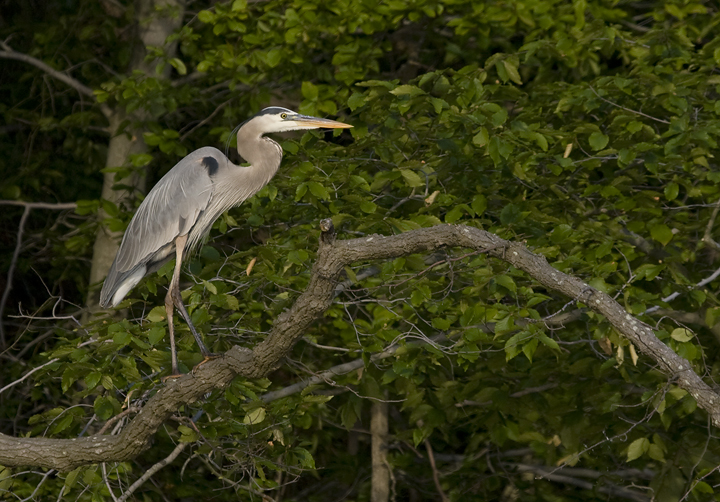
I didn't have my camera with me today when Gordon and I took Tilly for a walk at Seneca Creek State Park, but we saw one of these herons. We were walking down a steep path with root steps, and we spooked it. It lifted off a branch above us and swooped down to land in a little creek we were about to cross.

I un-gracefully squawked, "HOLY CRAP!" It's wings were so wide and it was so close to us that it shadowed us for a second. It was such a cool steely gray, so weirdly alien. It went to stand in the gummy, grimy water, and it watched us out of the corner of its eye as we passed. It took a few slow-motion steps forward, watching Tilly. Tilly was completely oblivious to it. I swear, she would be a terrible hunting dog. (She doesn't even chase squirrels unless they're climbing up her screen.)

The heron eventually decided that we were boring and continued to gaze out over the lake, and we went on. It was a really good walk though. We met a nice couple twice. They have a farm in Gaithersburg, and a Pomeranian. The husband wants a motorcycle. It is their new years resolution to walk more often, but the wife is bored with their neighborhood, so the husband took her to the park. I never learned their names, but we met them twice and they laughed at my dumb joke. And they liked Tilly's boots and backpack.

Everyone loves Tilly. She is kind of universally adorable. And don't get me wrong, of course, I think my dog is adorable. But people seem drawn to her. People stop their cars and get out to pet her. They roll down their windows and yell. Almost every single person I pass with her stops, or at least says something. I think I might make her a youtube channel or something. She does some pretty adorable things. Like her dervishing, and when she lays down and does her wiggles like a kid at a roller rink playing dead bug. :)

Anyway, in other news, I joined some groups on Meetup.com, and they look promising. One is a doing-things-with-dogs group. They do activities and walks and such. Another is a writing/art group that is having a meetup in Silver Spring on Wednesday. Man. People getting together to write and do art? Sign me up! Hehe. I'm trying to get Gordon to go, but kind of half-heartedly. I mean, I'd love it if he went, but I have to get used to doing things on my own. He's going to be in field med in June, and then deployed probably. So I have to be able to make friends and find things to do by myself. I'm so bored lately. Chronically bored. You can tell by my past two posts. Boredom just turns my thoughts inward, and that can be a terrible thing. I do so much better if I don't force things.

Well, oddly enough for lately, I'm actually kind of tired. I'm going to start ending each of my posts with a quote from a book or movie or song that I've been thinking about. I used to do that on my Xanga about a thousand years ago, and it's the only thing I liked about it. :)

So without further ado, so long, farewell, auf Wiedersehen, goodnight.

"The idea hovered and shimmered delicately, like a soap bubble, and she dared not even look at it directly in case it burst. But she was familiar with the way of ideas, and she let it shimmer, looking away, thinking about something else." - The Golden Compass by Philip Pullman